Lending Protocol and Single Asset Vaults are disabled on Devnet. You have two options for testing these features:
- Run
rippledin stand-alone mode and enableLendingProtocolandSingleAssetVaultin the rippled.cfg file. - Connect to the Lending Protocol-specific Devnet at
https://lend.devnet.rippletest.net:51234/.
The Lending Protocol is an XRP Ledger DeFi primitive that enables on-chain, fixed-term, uncollateralized loans using pooled funds from a Single Asset Vault. The protocol is highly configurable, enabling loan brokers to easily tune risk appetite, depostitor protections, and economic incentives.
The implementation relies on off-chain underwriting and risk management to assess the creditworthiness of borrowers, but offers peer-to-peer loans without intermediaries like banks or financial institutions. First-loss capital protection is used to help offset losses from loan defaults.
The current implementation of the lending protocol doesn't include automated on-chain collateral and liquidation management, instead focusing on on-chain credit origination.
To ensure compliance needs are met, asset issuers can claw back funds from the vault associated with the lending protocol. Issuers can also freeze individual accounts or issue a global freeze.
(Requires the Lending Protocol amendment )
There are three parties involved in the process of creating a loan:
- Loan Brokers: Create asset vaults and manage associated loans.
- Depositors: Add assets to vaults.
- Borrowers: Receive loans, making repayments as defined by their loan terms.
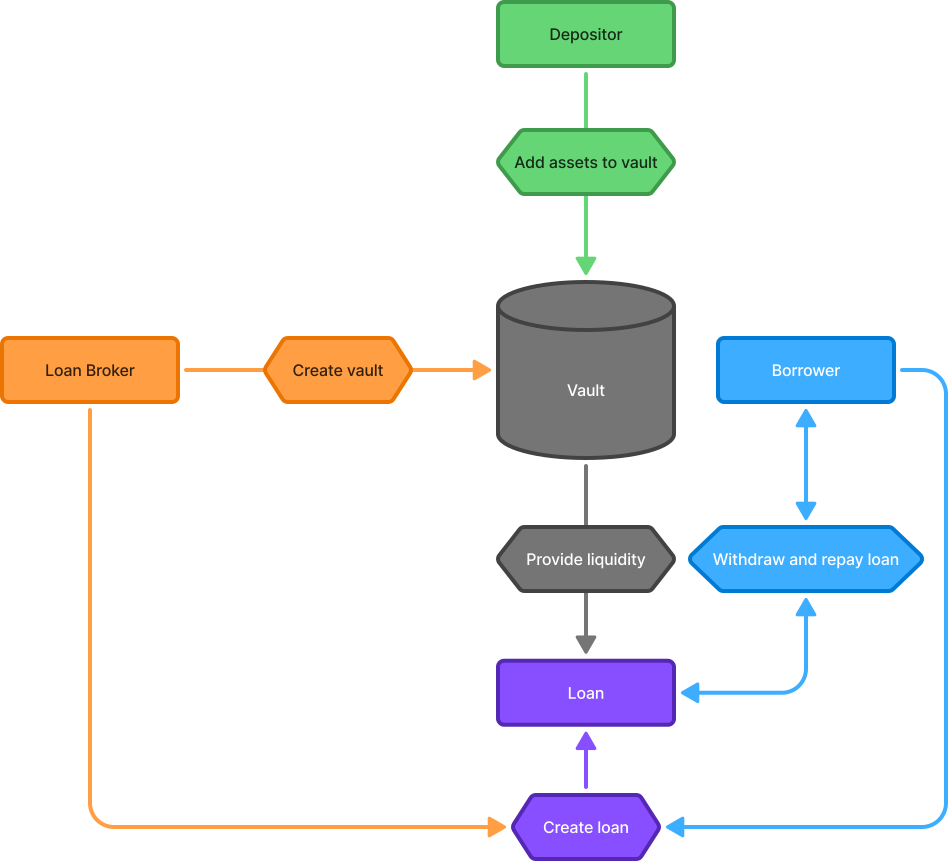
The lifecycle of a loan is as follows:
- A loan broker creates a vault.
- Depositors add assets to the vault.
- (Optional) The loan broker deposits first-loss capital.
- A loan broker and borrower create a loan, defining the terms of the loan, and the requested principal (excluding fees) is transferred to the borrower.
- If payments are missed, the loan enters a grace period. Once the grace period expires, the loan broker has the option to default the loan.
- The loan is deleted when matured or defaulted.
- (Optional) The loan broker can withdraw first-loss capital.
- After all loans are paid, the loan broker can delete the
LoanBrokerledger entry, and then the correspondingVaultledger entry.
First-Loss Capital is an optional mechanism to mitigate the risks associated with lending. To protect investors' assets, a loan broker can deposit assets as first-loss capital, which acts as a buffer in the event of loan defaults. The first-loss capital is placed into the vault to cover a percentage of losses from missed payments.
Three parameters control the First-Loss Capital:
CoverAvailable: The total amount of cover deposited by the lending protocol owner.CoverRateMinimum: The percentage of debt that must be covered byCoverAvailable.CoverRateLiquidation: The maximum percentage of the minimum required cover (DebtTotal x CoverRateMinimum) that will be placed in the asset vault to cover a loan default.
Whenever the available cover falls below the minimum required:
- The loan broker can't issue new loans.
- The loan broker can't receive fees. All fees are added to the First-Loss Capital to cover the deficit.
Below is an example of how first-loss capital is used to cover a loan default:
** Initial States **

-- Vault --
AssetsTotal             = 100,090 Tokens
AssetsAvailable         = 99,000 Tokens
SharesTotal             = 100,000 Tokens

-- Lending Protocol --
DebtTotal               = 1,090 Tokens
CoverRateMinimum        = 0.1 (10%)
CoverRateLiquidation    = 0.1 (10%)
CoverAvailable          = 1,000 Tokens

-- Loan --
PrincipleOutstanding  = 1,000 Tokens
InterestOutstanding   = 90 Tokens


# First-Loss Capital liquidation maths

DefaultAmount = PrincipleOutstanding + InterestOutstanding
              = 1,000 + 90
              = 1,090

# The amount of the default that the first-loss capital scheme will cover
DefaultCovered      = min((DebtTotal x CoverRateMinimum) x CoverRateLiquidation, DefaultAmount)
                    = min((1,090 * 0.1) * 0.1, 1,090) = min(10.9, 1,090)
                    = 10.9 Tokens

Loss                = DefaultAmount - DefaultCovered
                    = 1,090 - 10.9
                    = 1,079.1 Tokens

FundsReturned       = DefaultCovered
                    = 10.9

# Note, Loss + FundsReturned MUST be equal to PrincipleOutstanding + InterestOutstanding

** State Changes **

-- Vault --
AssetsTotal     = AssetsTotal - Loss
                = 100,090 - 1,079.1
                = 99,010.9 Tokens

AssetsAvailable = AssetsAvailable + FundsReturned
                = 99,000 + 10.9
                = 99,010.9 Tokens

SharesTotal = (UNCHANGED)

-- Lending Protocol --
DebtTotal       = DebtTotal - PrincipleOutstanding + InterestOutstanding
                = 1,090 - (1,000 + 90)
                = 0 Tokens

CoverAvailable  = CoverAvailable - DefaultCovered
                = 1,000 - 10.9
= 989.1 TokensIf the loan broker discovers a borrower can't make an upcoming payment, impairment allows the loan broker to register a "paper loss" with the vault. The impairment mechanism moves the due date of the next payment to the time the loan is impaired, allowing the loan to default more quickly. However, if the borrower makes a payment before that date, the impairment status is automatically cleared.
Issuers (trust line token or MPT, not XRP) can claw back funds from First-Loss Capital. To ensure there is always a minimum amount of capital available to protect depositors, issuers can't claw back the entire available amount. Instead, they can claw back up to a minimum amount of First-Loss Capital that the loan broker must maintain for the lending protocol; the minimum amount is calculated as LoanBroker.DebtTotal * LoanBroker.CoverRateMinimum.
Freezing is a mechanism by which an asset issuer (trust line token or MPT, not XRP) prevents an account from sending their issued asset. Deep freeze takes this a step further by preventing an account from sending and receiving issued assets. Issuers can also enact a global freeze, which prevents everyone from sending or receiving their issued asset.
In all freeze scenarios, assets can be sent back to the issuer.
If a borrower has their account frozen or deep frozen, they can't make loan payments. This doesn't absolve a borrower of their repayment obligations, and they will eventually default on their loan.
Freezing a borrower's account won't affect a loan broker's functions, but it will prevent them from receiving any lending protocol fees. However, issuers can freeze a loan broker's pseudo-account and prevent the loan broker from creating new loans; existing loans won't be affected. A deep freeze on a loan broker's pseudo-account also prevents loans from being repaid.
There are three interest rates associated with a loan:
- Interest Rate: The regular interest rate based on the principal amount. It is the cost of borrowing funds.
- Late Interest Rate: A higher interest rate charged for a late payment.
- Full Payment Rate: An interest rate charged for repaying the total loan early.
The lending protocol charges a number of fees that the loan broker can configure. The protocol won't charge these fees if the loan broker hasn't deposited enough first-loss capital.
- Management Fee: This is a percentage of interest charged by the loan broker. Vault depositors pay this fee.
- Loan Origination Fee: A fee paid to the loan broker, taken from the principal amount loaned out.
- Loan Service Fee: A fee charged on top of each loan payment.
- Late Payment Fee: A fee paid on top of a late payment.
- Early Payment Fee: A fee paid on top of an early payment.
Loan payments are evaluated and processed around three criteria: amount, timing, and specified flags. The combination of these criteria determine how funds are applied to the loan's principal, interest, and associated fees.
Each payment consists of four components:
- Principal: The portion that reduces the outstanding loan principle.
- Interest: The portion that covers the cost of borrowing for the period.
- Fees: The portion that covers any applicable service fees, management fees, late payment fees, or other charges.
- ValueChange: The amount by which the payment changes the loan balance.
When the loan payment is submitted, the lending protocol then checks these parameters:
- Timing: Is the payment on time or late?
- Amount: Does the payment amount meet the minimum required amount, or exceed it?
Based on the timing and transaction flags, the lending protocol processes the payment as one of four types:
On-Time Payments: If the payment is on-time, it's further classified into these payment scenarios:
- Sequential Periodic Payments: The payment is applied to as many complete payment cycles as possible; cycles are calculated as the amount due each payment period (including fees).
- Overpayments: After all possible cycles are fully paid, any remaining amount is treated as an overpayment and applied to the principal. This type of payment requires the
lsfLoanOverpaymentflag to be enabled on theLoanledger entry, as well as thetfLoanOverpaymentflag to be enabled on theLoanPaytransaction. If these flags are missing, the excess amount is ignored. - Full Early Repayment: The payment has the
tfLoanFullPaymentflag set, and the amount covers the remainder of the loan (including fees).
Late Payments: The payment is late on a payment cycle. Late payments must be for an exact amount, calculated as:
totalDue = periodicPayment + loanServiceFee + latePaymentFee + latePaymentInterestOverpayments aren't permitted on late payments; any excess amount is ignored.
In scenarios where excess payment amounts are "ignored", the transaction succeeds, but the borrower is only charged on the expected amount.